


The voices of experts, journalists and activists – The professionals have their say (Part 5)
12. Studio Q – „+3 degrees by 2050? New climate report: Will everything get EVEN worse?“
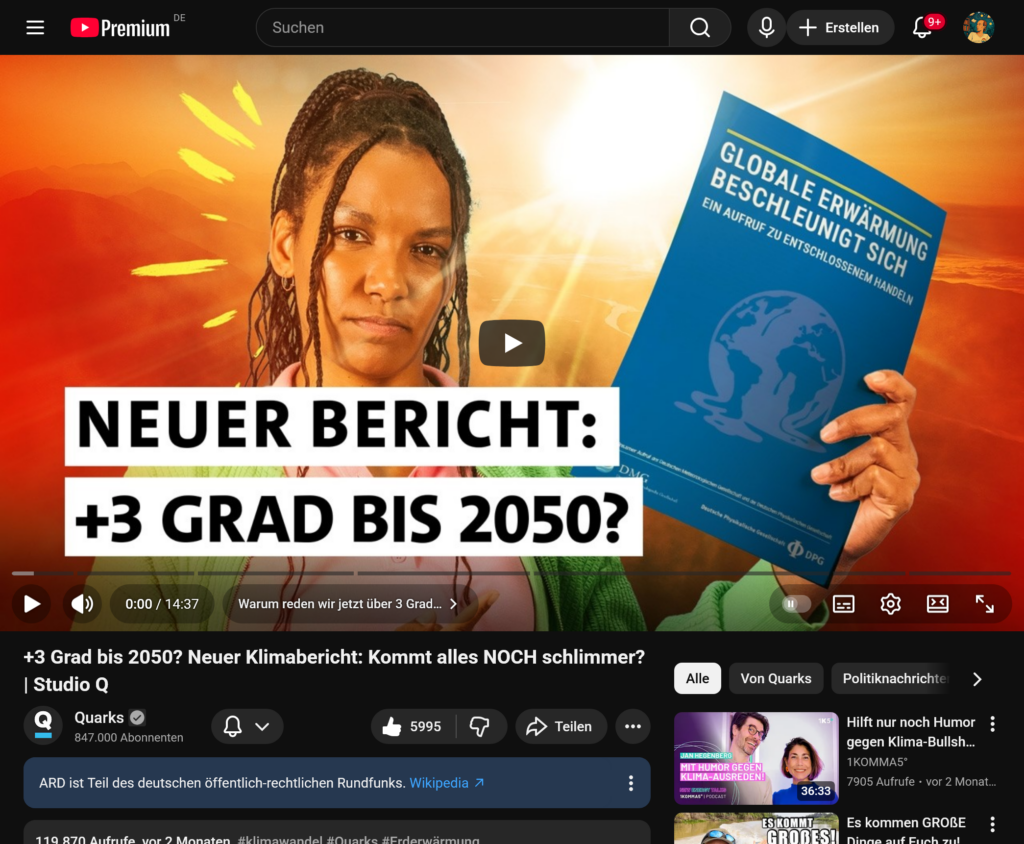
This video discusses new climate model results.1+3 degrees by 2050? New climate report: Will everything get EVEN worse? | Studio Q 🌐 https://youtu.be/VmQSlIYOIQE .
The message:
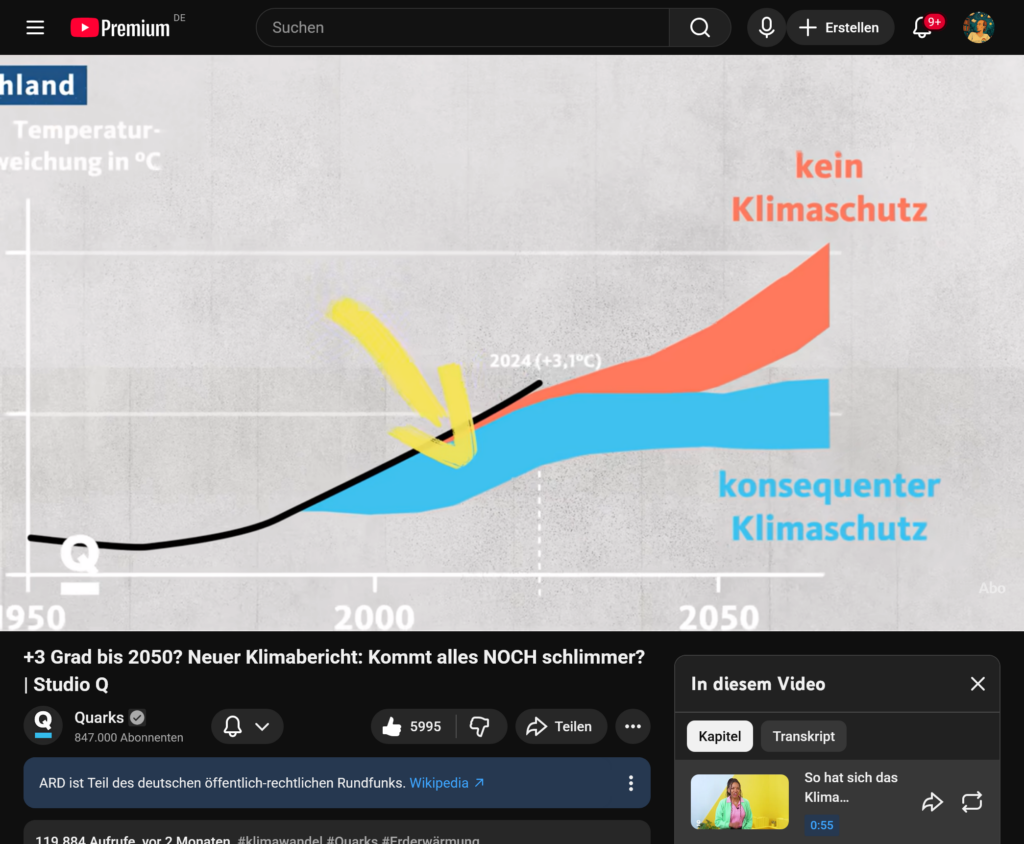
- Current climate models show that we are heading for a 2.8–3.0 degree rise in temperature (not 2.0–2.4 as previously assumed).
- This has disastrous implications.
- We are already at +1.5 degrees warming on a 12-month average.
- The models no longer apply – reality is worse than the worst-case forecasts.
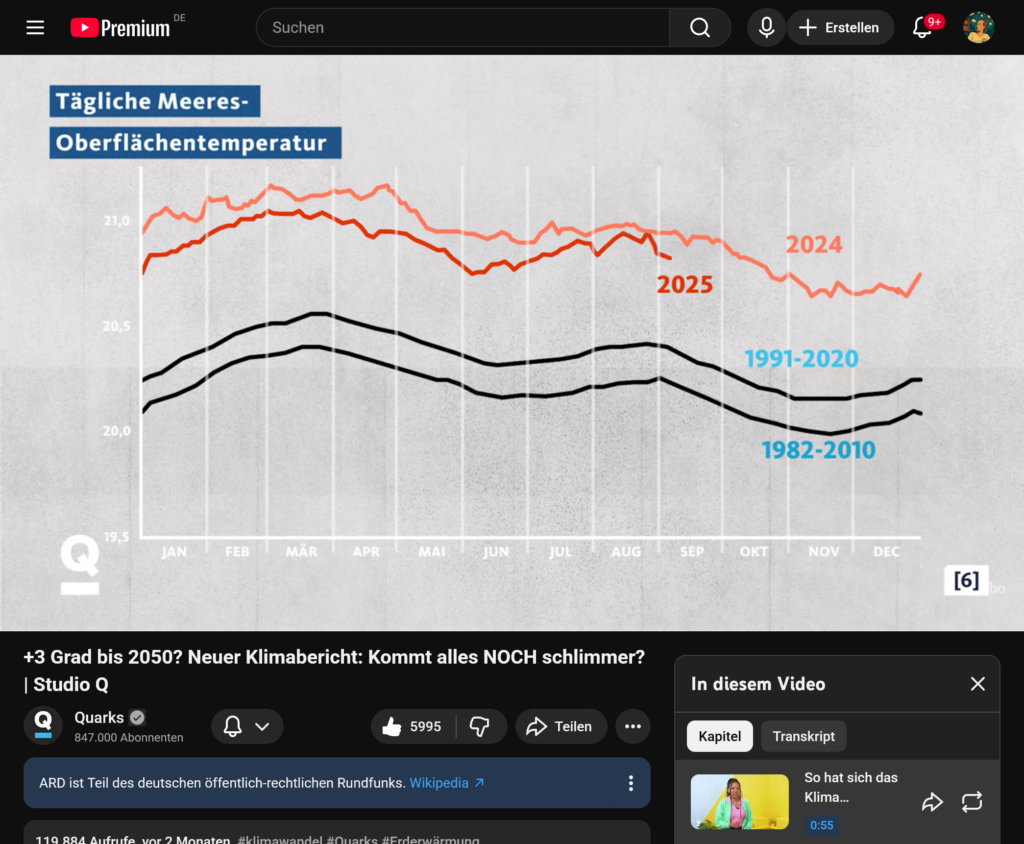
„The black line? That's the average temperatures over the last few decades. The last two years have exceeded forecasts – the Mediterranean was so warm this summer that the observation stations ran out of colour. This data also formed the basis for yesterday's new report: the German Meteorological and Physical Society says that the Earth is warming faster than previously thought. The Paris targets – to stay between 1.5 and 2° – are becoming increasingly unrealistic. +3° could already be exceeded by 2050.“3+3 degrees by 2050? New climate report: Will everything get EVEN worse? – Verbatim quotes from my memory log | Studio Q 🌐 https://youtu.be/VmQSlIYOIQE
Implication for COP30:
At this very moment, COP30 decided practically nothing new. Science is sounding the alarm bells – politicians are responding with minimal compromises.
„We are now at around 425 ppm CO₂ in the atmosphere. The atmosphere is drifting towards a stable system at around 3.5°. These are stored in the climate system – and because we only want to become climate neutral by 2045 (some of us, at least), CO₂ particles are still being added... so we are heading for almost 5° by 2100.“
And Frank Böttcher (German Meteorological Society) adds: „We really can no longer rule out the possibility of global warming reaching 3°C by 2050.“
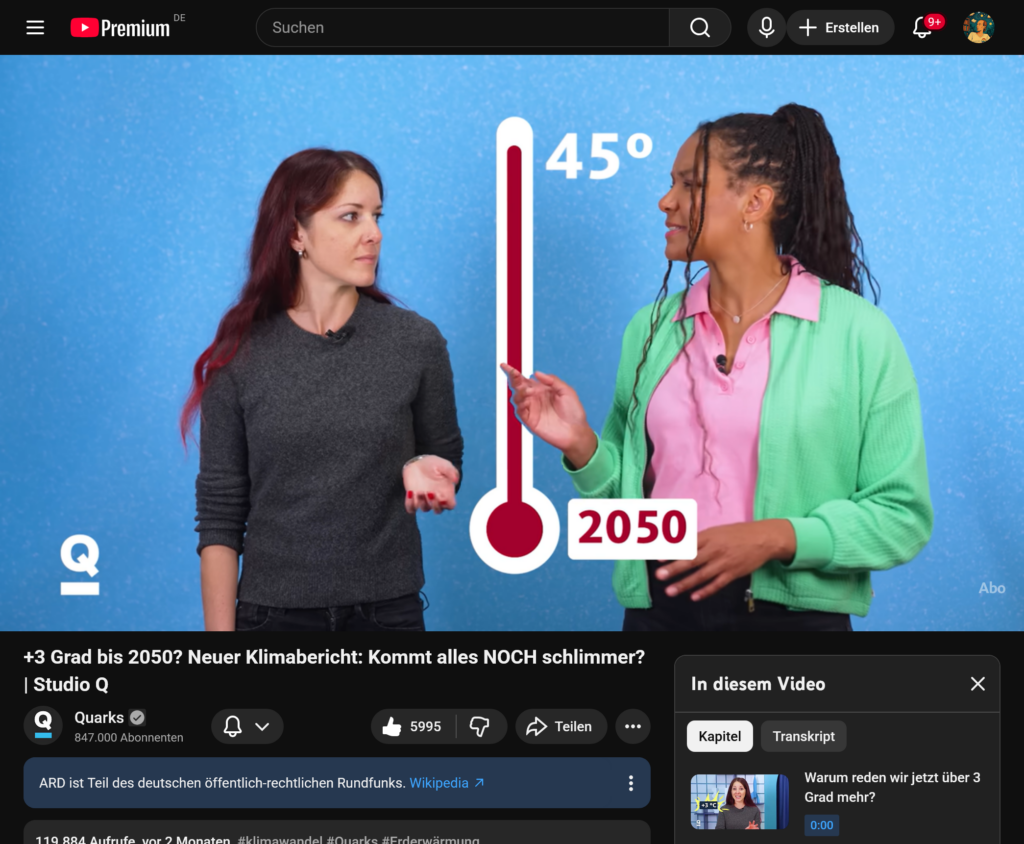
I can and would like to recommend this Quarks report without reservation. It is exciting, lively and, despite the serious subject matter, entertaining and enjoyable. The half hour is time well spent. This is especially true for those who are not interested in the topic and for climate sceptics. Winking smiley.

„Even today, thousands of people die every year as a result of heat (2018: 8,500 deaths). If you think this only affects the elderly, just think 25 years ahead. Children, young people and people with pre-existing conditions are also affected. Medicines suddenly have a different effect. Allergies are on the rise. Heat puts a strain on the psyche, makes people more aggressive, and increases the number of suicides and illnesses.“
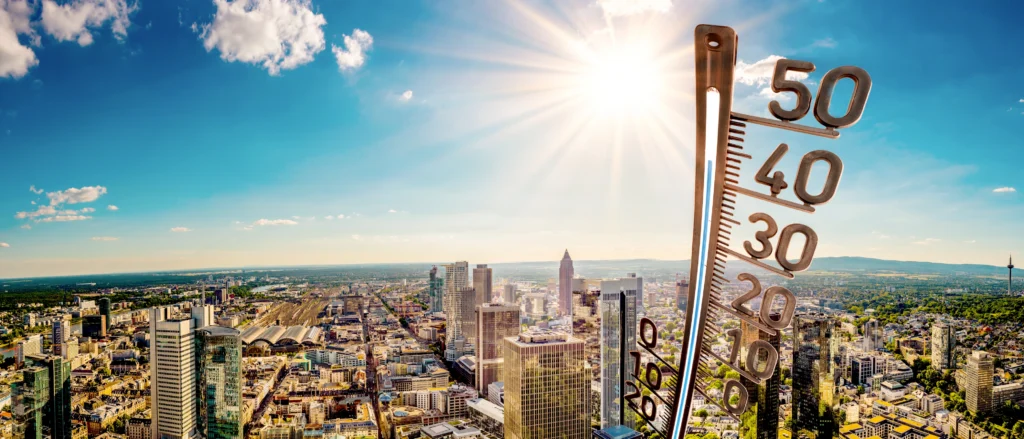
„We have to be honest: this topic makes us, as editors, feel sad, hopeless and desperate. It's impossible to really imagine +3°C – those are hostile conditions. Our infrastructure cannot withstand it, and life in hot regions of the world will become impossible.“
13. Terra X Lesch & Co – Harald Lesch: „The unfair truth behind global warming“
The well-known science journalist Harald Lesch – another of my top favourites – analyses the injustice of the climate crisis.7The unfair truth behind global warming | Harald Lesch | Terra X Lesch & Co 🌐 https://youtu.be/Kpvd4QdetOs .

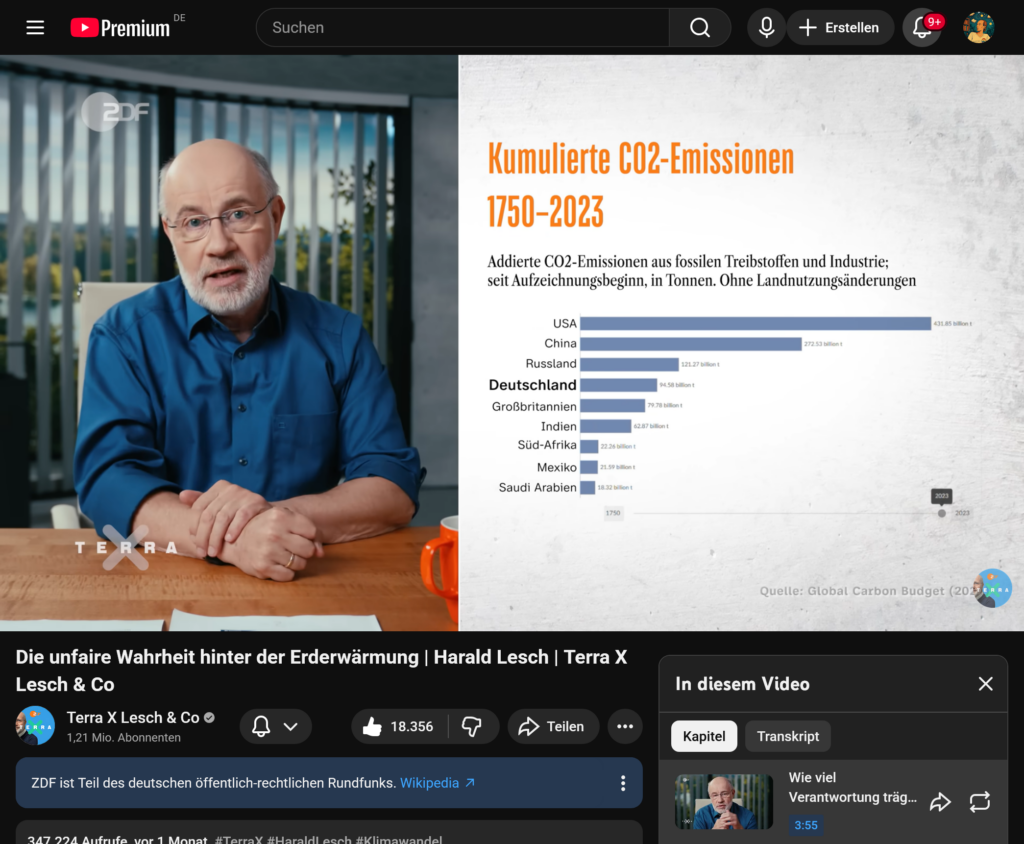
I would also love to throw this video in the face of our wannabe climate chancellor Friedrich Merz the next time he claims that Germany is only responsible for 2% of emissions in the atmosphere. That may be the case today, but where, Mr Merz, have you hidden our emissions from the past 100 years? They are still in the Earth's atmosphere, yesterday as today, tomorrow as the day after tomorrow. The complete breakdown of CO2 by natural means (weathering and rock formation) takes at least tens of thousands to 100,000 years.9Deutschlandfunk: The long-term impact of CO2 🌐 https://www.deutschlandfunk.de/1-jahrtausend-der-lange-atem-des-co-100.html . In the meantime, we have even overtaken the United Kingdom, which is not only my mother's homeland, but also the country that epitomises industrialisation. There is no denying that. It is simply physics, Mr Merz. It is even simple physics, Mr Merz.
Lesch comments: „Germany has been one of the wealthiest countries in the world for several decades. One reason for this is that it has experienced several economic miracles. And that is why Germany is one of the countries responsible for the planet. Responsible for the large amount of carbon dioxide that has accumulated in the atmosphere. The accumulated It is the amount of carbon dioxide, because that stuff up there doesn't disappear, that contributes to the rise in temperature.“
To be fair, we would also have to add to our emissions all those emissions that, although generated in others countries, but were only created to ours To satisfy needs.
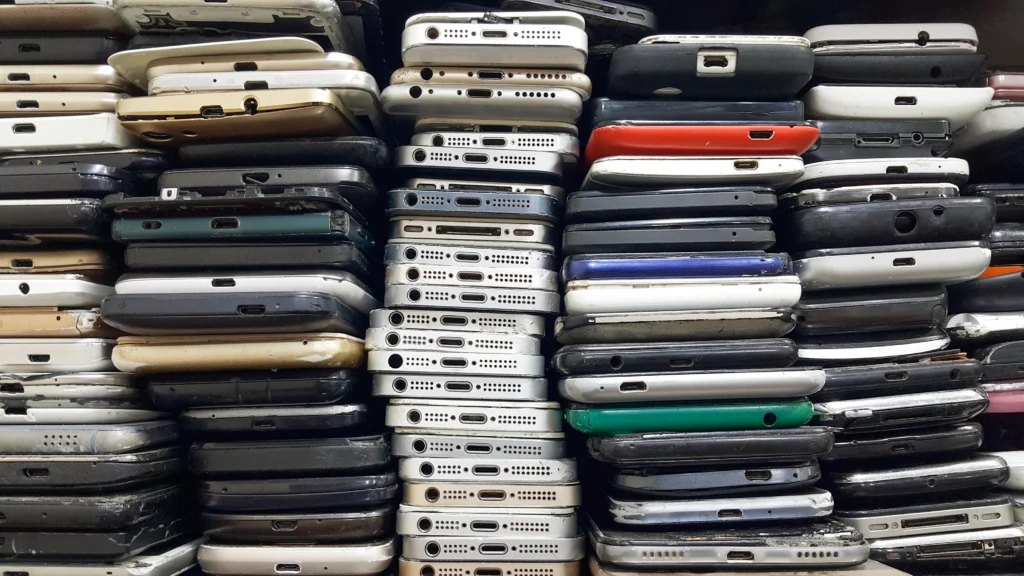
A new iPhone every two years (I've been told that nowadays people actually buy a new mobile phone every year, no comment) accounts for a whopping 74 kg CO₂e (e.g. iPhone 16 Pro Max), for which someone has to take responsibility. Why should the Southeast Asian rice farmer, whose island is already sinking due to climate change, also shoulder the costs and ecological footprint of our Black Friday electronic waste from the Far East?
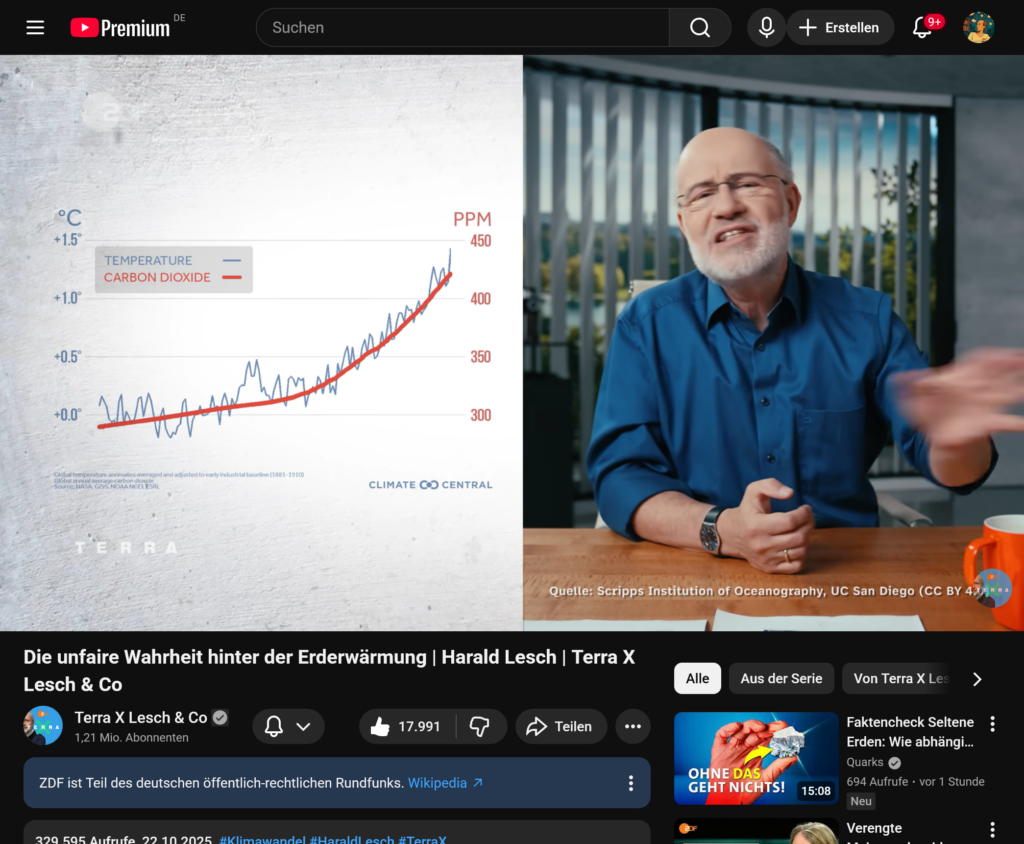
And continuing in this context: „We have a clear correlation between the cumulative amount of carbon dioxide in the atmosphere and the temperature. This means that all the pub discussions about what could be to blame – here is the answer, namely the cumulative amount of CO2 in the atmosphere, which correlates directly with the global mean temperature. This renders all discussions superfluous.“
Lesch's central thesis:
- The climate crisis is fundamentally unfair.
- The Global North has industrialised extensively, destroying the planet in the process.
- The Global South is hardest hit, even though it has contributed the least.
- Historical emissions: The West accounts for 79% of excess emissions since 1850.
- Today: China and India produce a lot of CO₂, but per capita, the West is still the leader.
I don't understand what the comparisons in absolute figures that critics keep bringing up are supposed to explain. Woohoo, a big nominal number. The Chinese, with their ecological footprint of around 13,260,000,000,000 kg CO₂e, compared to only around 4,682,000,000,000 kg CO₂e for the USA.12 USA: Carbon dioxide (CO2) emissions per capita 🌐https://www.theglobaleconomy.com/USA/Carbon_dioxide_emissions_per_capita 13 China: Carbon dioxide (CO2) emissions per capita 🌐https://www.theglobaleconomy.com/China/Carbon_dioxide_emissions_per_capita/ [/ footnote]. It's obvious that the Chinese are to blame for climate change. We're out. Not. 13 Carbon dioxide emissions of the most polluting countries worldwide in 2010 and 2023 🌐 https://www.statista.com/statistics/270499/co2-emissions-in-selected-countries/ [/ footnote] Figure: Carbon dioxide emissions of the most polluting countries worldwide in 2010 and 2024 (in million metric tonnes). Available online at https://www.statista.com/statistics/270499/co2-emissions-in-selected-countries/ Retrieved on 20 December 2025 for editorial use. 14 Carbon dioxide emissions of the most polluting countries worldwide in 2010 and 2023 🌐https://www.statista.com/statistics/270499/co2-emissions-in-selected-countries/ [/ footnote] – Courtesy of Statista

Find more statistics at Statista
And to make it roughly comparable: per capita, the Chinese emit around 9,400 kg CO₂e, compared to around 13,900 kg CO₂e for Americans.15 USA: Carbon dioxide (CO2) emissions per capita 🌐 https://www.theglobaleconomy.com/USA/Carbon_dioxide_emissions_per_capita . Who's wearing the trousers now?
Lesch's criticism of COP30:
- Without genuine compensation from the Global North, there can be no talk of justice.
- The agreed 300 billion US dollars is an insult to the requirement of 400+ billion.
- It is a system that punishes the poor and spares the rich.
Lesch's key question:
„Why should poor countries limit their development when rich countries are not prepared to reduce their overproduction?“
14. „Money for the world“ Maurice Höfgen on fossil fuel lobby strategies
It's time to introduce you to someone else who usually deals with economics, money and politics. I have occasionally quoted him on political issues. Maurice Höfgen is an economist, independent journalist and YouTuber. His videos tackle even difficult topics with a certain sublime lightness, which makes them enjoyable to watch.
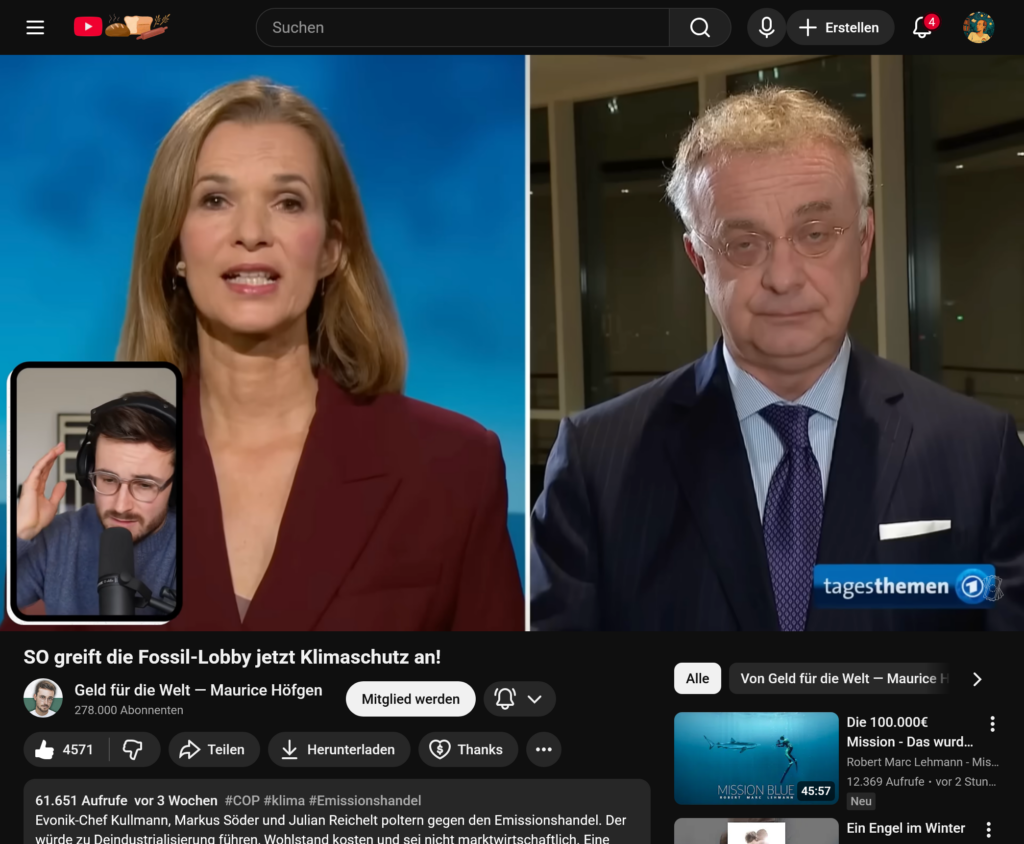
A video analyses how the fossil fuel lobby is now conducting its attacks against climate protection.17This is how the fossil fuel lobby is now attacking climate protection! 🌐https://youtu.be/TBF9fWkOsRY . The fossil fuel lobby is simply an overpowering final boss. They will milk the earth dry. Why not? The money keeps rolling in. Definitely, still. Winking smiley.
The same could be said of CO₂ certificate trading. Maurice criticises the way emissions trading is handled. The fossil fuel lobby is delighted.
Maurice puts the latest EU decisions on climate targets in the context of the upcoming World Climate Conference, where Europe's targets for the negotiations are to be set. He points out that a crucial compromise was reached on Tuesday night: In future, climate targets will also be achieved by EU countries purchasing foreign climate certificates – an instrument familiar from airlines, for example, which, despite high emissions, „dress up“ their carbon footprint by purchasing certificates for alleged reforestation or forest protection projects in other regions of the world. At the same time, he recalls the numerous reports about the high susceptibility of many of these projects to corruption and points out that in the past, they have often been dubious or even completely fictitious projects that primarily served to make money.

Using the practical example of a Tagesschau interview with Evonik CEO Kullmann, Maurice vividly demonstrates the methods used here. Markus Söder and Julian Reichelt also rail against emissions trading. They claim it would lead to deindustrialisation, cost prosperity and is not market-based. A lie! Quote from Maurice.
In his commentary, Maurice paints an extremely critical picture of Evonik CEO Christian Kullmann, describing him as the personification of everything he rejects about the fossil fuel lobby. In his portrayal, Kullmann stands for a mixture of pseudo-objective arguments, condescending lobbyist chatter and the attitude of an „old white man“ who clearly has no desire to face critical questions and instead argues with positions that lack substance.
„Companies do not plan in election cycles, but in decades.“
Maurice Höfgen, economist. 18 Money for the world — Maurice Höfgen YouTube presence„This is how the fossil fuel lobby is now attacking climate protection!„Available online at https://youtu.be/TBF9fWkOsRY Retrieved on 30 November 2025. Editorial use. 🌐 https://youtu.be/TBF9fWkOsRY
At the same time, Höfgen emphasises that Kullmann is not alone in this stance, but can rely on the support of a network of other industry leaders, lobbyists, political supporters such as Markus Söder, and a right-wing media landscape that is sympathetic to his views.
Observed strategies of the fossil fuel lobby, the „playbook“So to speak:
- greenwashingOil companies present themselves as climate saviours (Shell, Exxon Mobil with „energy transition“)
- Political lobbying: Funding politicians who fuel climate scepticism, such as Markus Söder
- Media campaigns: Sowing doubt about climate change (despite 99.9% scientific consensus), especially in the right-wing press
- delaying tactics„We will have solutions in 10 years“ – perpetually postponed
- Political deadlock at COPs: Oil states as presidents/blockers (such as the UAE at COP28, Azerbaijan at COP29)
Implication for COP30:
The lobby was also present in Belém – lobbyists from the fossil fuel industry sat in the negotiating rooms. This is a conflict of interest that is fundamentally inappropriate.
And just how much even the oh-so-powerful Bavarian Minister-President and his CSU party are being lulled by the fossil fuel lobby, and what impact this is already having on us citizens today, is something I have written about in the following slightly satirical article: Anti-social right-wing politics in favour of the richest19 Anti-social right-wing politics that favour the richest 🌐 https://paddys.de/gute-nacht-umweltschutz-teil-1-warum-der-gruene-kompromiss-asozial-rechte-politik-zugunsten-der-reichsten-bedeutet/

15. The Trump effect on COP30
The auslandsjournal podcast format, which I always listen to with interest and enjoyment, analysed how Trump's behaviour influenced COP30.21COP without Trump: What does this mean for the climate? | The Trump Effect #32 | auslandsjournal – the podcast 🌐 https://youtu.be/4VOKxGcFszc .

The introductory remarks by Elmar Theveßen and a quote from UN Secretary-General António Guterres convey the prevailing mood well:
„Every Tenth of a degree more Global warming means more Hunger, more displacement, more loss. And with current global climate policy, we are heading for 2.8° by the end of the century.“ UN Secretary-General António Guterres
Elmar adds:
„The 1.5° target is becoming increasingly distant, say the United Nations, warning of climate collapse.“ Elmar Theveßen
Or also correct and important:
„Good climate change policy is ultimately a good migration policy, What happens if hunger and poverty ultimately mean that what we have experienced in terms of migration in recent years was actually just the prelude?“ Elmar Theveßen
ZDF correspondent Winnie Heescher reports directly from the COP in Brazil and does not mince her words, openly addressing the fundamental problems of this very special COP:
„One also wonders: Is it right that so many people are travelling and generating all these air miles, and we've all been given a water bottle? You get one at every UN conference, and I found that particularly absurd because there are no water dispensers more, and we have good reasons for this. cans get, of which you do about 5 to 10 a day, Produced in Germany." ZDF correspondent Winnie Heescher
„First of all, there is a sad aspect to this conference, because the Accommodation so expensive have become, can be completely many countries only send small delegations send, if they can send any at all. And of course, this also applies to civil society and NGOs.“ ZDF correspondent Winnie Heescher
This argument has not been given enough attention in the public debate. On the one hand, it is always argued that the COP is the only place where everyone from around the world comes together. That's all well and good. But if the poorest countries, which have contributed the least to climate change but suffer the most from its consequences, are not represented, then something is wrong.

Influence:
- The US under Biden was back in the climate process (after Trump I)
- But: Everyone knew that Trump could return.
- With Trump II (2025-2029), the US is effectively out of the climate process.
- This weakens the system massively – because the US is still a superpower.
- China must fill the gap somehow, but it also has its own interests.
Strategic implication:
COP30 was therefore also an attempt to work with the knowledge that the US might no longer be involved. This led to less ambitious targets and blockades from others.
Elmar Theveßen points out that China plays a dominant role in key future technologies: around 88 per cent of global solar technology and battery production and around 72 per cent of wind turbines come from the People's Republic, and China also accounts for more than half of global hydrogen technology. At the same time, however, the country remains the largest emitter of greenhouse gases: he cites emissions of around 13 billion tonnes of CO₂ for 2024, which corresponds to around one third of global CO₂ emissions, with worldwide emissions totalling around 39 billion tonnes.
Ulf Röller is head of the ZDF studio in Brussels and thus the chief foreign correspondent responsible for reporting on the EU, NATO and the Benelux countries. In this context, he warns of the political consequences of a massive loss of prosperity in Europe: the 2027 elections in Poland and France will be decisive, and many representatives of the political centre believe that a gain in power by right-wing populist forces – such as the PiS in Poland or Marine Le Pen in France – could lead to the European Union no longer continuing in its current form.
To sweeten the wait until the next episode, click here to go directly to the podcast: https://youtu.be/4VOKxGcFszc