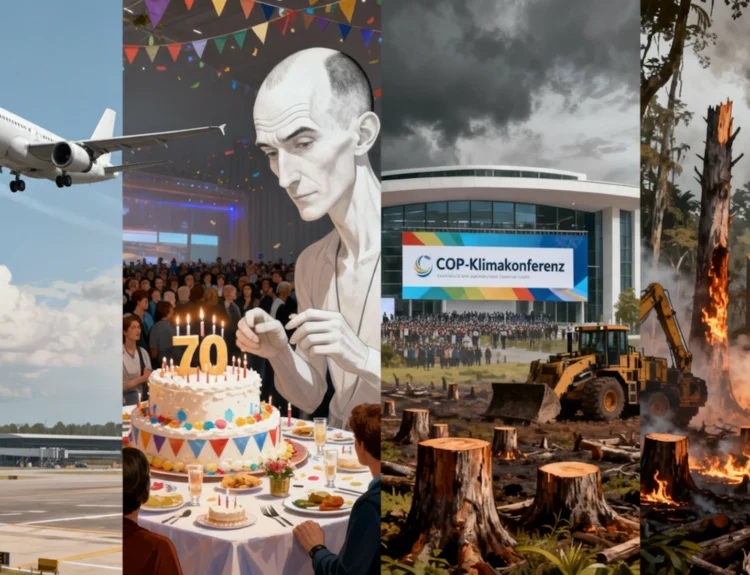


The voices of experts, journalists and activists – The professionals have their say (Part 4)
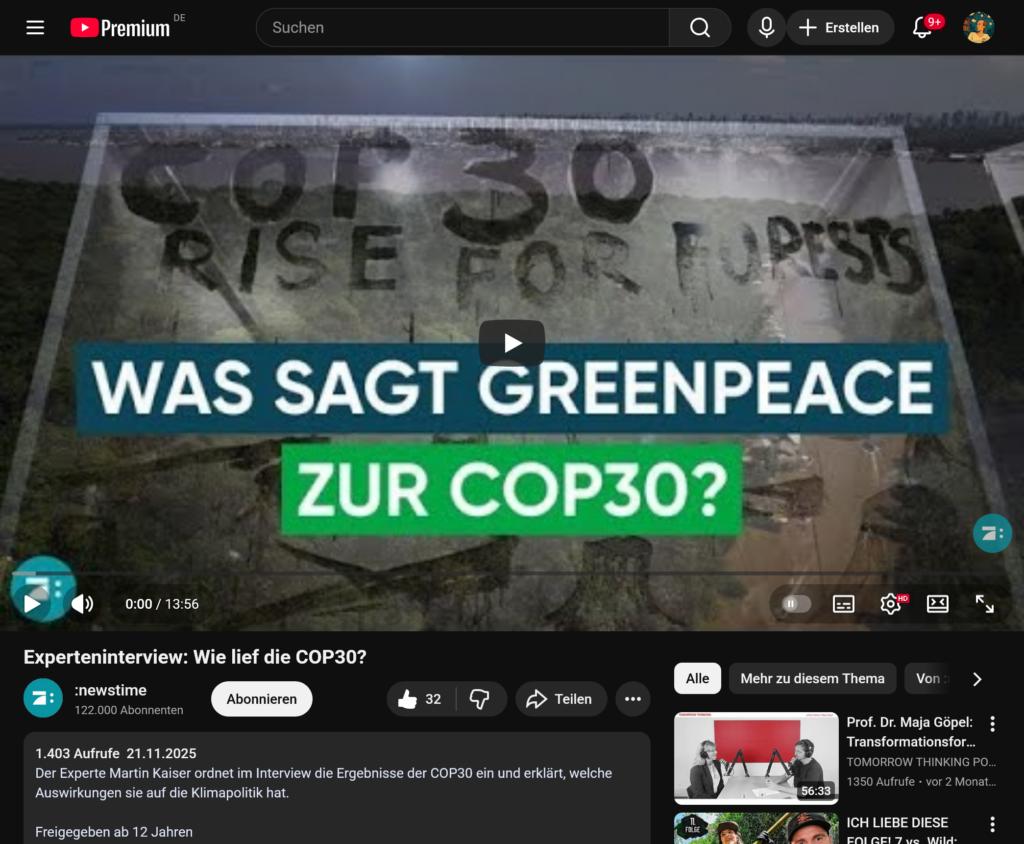
6. Expert interview: Martin Kaiser (Greenpeace) – „How did COP30 go?“
Greenpeace director Martin Kaiser gave a detailed interview on COP30 and summarised the situation precisely: the climate conference was a minimal compromise that did not solve the fundamental problems.1Expert interview: How did COP30 go? 🌐 https://youtu.be/NTq2IUhf4Gw .
Kaiser's key messages:
- The conference ended without a binding plan to phase out fossil fuels.
- Climate finance fell significantly short of what was needed
- Countries of the Global South leave the conference feeling betrayed
- Fossil fuel countries have once again made full use of their veto power
- A system that relies on unanimity cannot prevail against a few blockers.
- Greenpeace and other NGOs ran massive pressure campaigns during the conference, but were unable to resolve the structural problems.

7. Tagesthemen interview with Maja Göpel (transformation researcher)
Maja Göpel is a leading transformation researcher and was interviewed at COP30.3COP: Transformation researcher Göpel calls for more climate protection | tagesthemen interview 🌐 https://youtu.be/jwbUjDk0MqY .
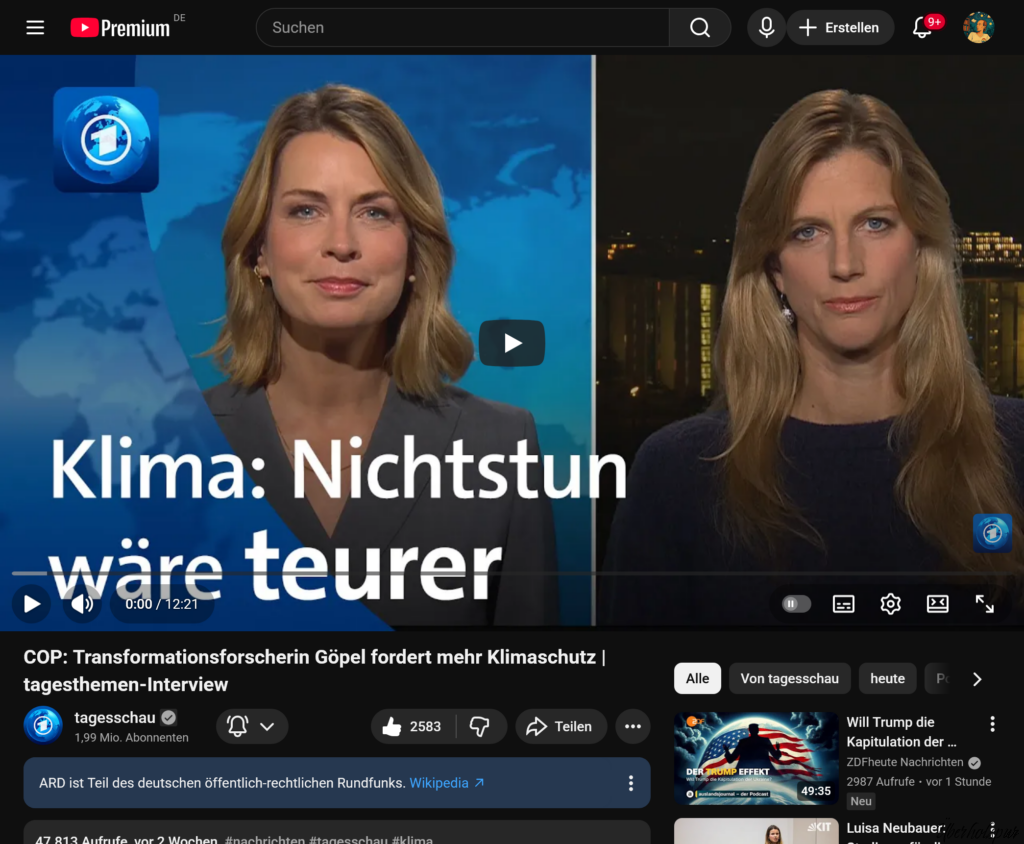
Maja's assessment:
- The climate is having a particularly difficult time in Germany because CO₂ is invisible, cause and effect are extremely delayed, and we believe that it will not affect us.
- Furthermore, disinformation is clearly being spread by the powerful fossil fuel lobby.
- The extent to which Friedrich Merz is now supposed to be the climate chancellor is relatively new to her and seems unfounded.
- We Germans are not good at transformation when disaster has not yet struck us.
- The COP is a negotiation system that leads to „minimal compromises“.
- Real transformation does not happen at international conferences, but through pressure from civil society, elections and market changes.
- The COP is important for determining who is still participating, especially individual countries and cities.
- Individual countries or coalitions must take the lead – the consensus principle does not work
- It is shameful that the wealthiest players are simply opting out.
- Social cohesion is essential for a just climate transition
- Without social compensation, there will be no majority support for climate protection.
Göpels„ core statement: “We must think locally and act globally – not the other way around."
8. ARD Germany Trend – „How important is climate change to people in Germany?“
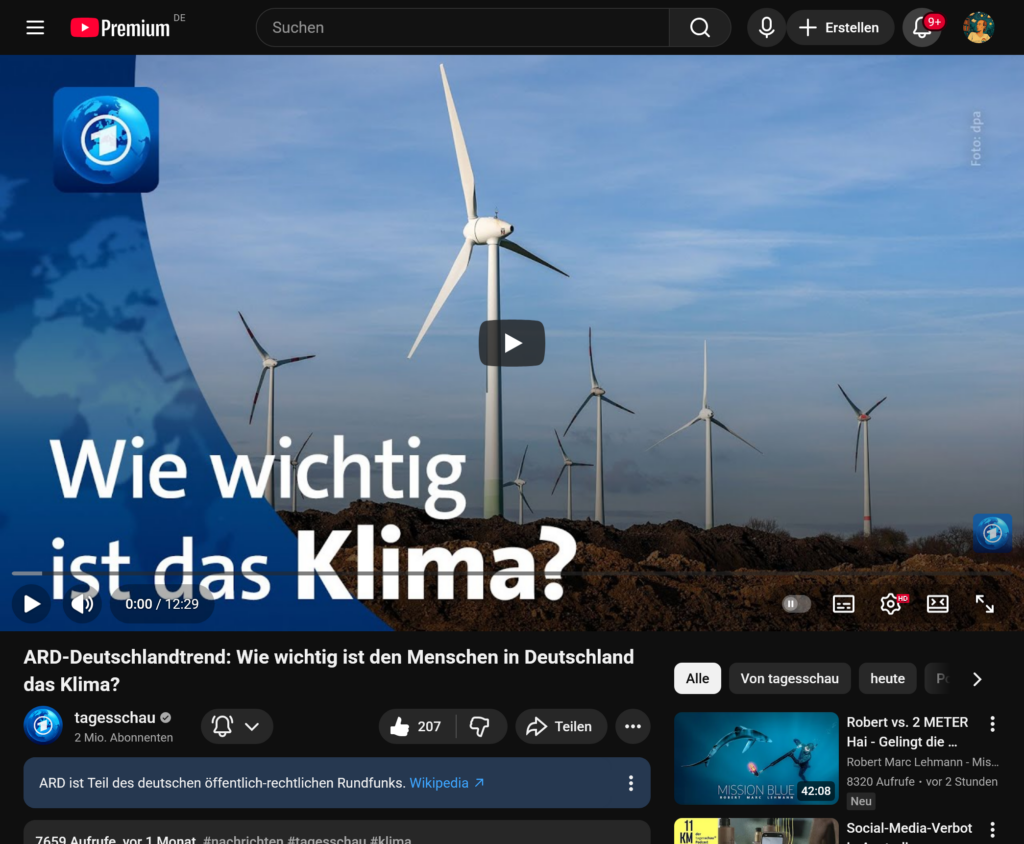
This post was a survey on climate awareness.5ARD Germany Trend: How important is climate change to people in Germany? 🌐 https://youtu.be/xp8kpj-RsYM .
Results:
- President Lula announces a £125 billion forest protection fund, the proceeds of which will be used to „compensate“ nations that preserve primary forests (rainforests, virgin forests). not Deforest. Forests must be viewed as an economic factor, their ecosystem services recognised and incorporated into GDP. A nice idea, but unfortunately only 5 billion has been raised, which I find somewhat indicative of international climate protection efforts.
It's no use, I still have to comment get rid of. And it doesn't help, my comment just became too much for in between. You'll find it here starting tomorrow: Lula's Rainforest Fund – personal commentary
- Around 50,000 participants from over 190 countries
- Even before the event begins, numerous locals demonstrate for the protection of their living conditions, such as the preservation of their forest habitat.
- Christiane Averbeck from the Climate Alliance Germany association comments that Merz's appearance is a good sign, but that a very specific climate stimulus package must follow as a matter of urgency.
- In an interview, Environment Minister Schneider emphasises the importance of sticking to existing climate targets.
- Climate protection is supported when it does not „hurt“
- This highlights the central dilemma: in the eyes of many concerned people, genuine transformation requires sacrifices – but the population has little appetite for these if they are not distributed fairly.
Implication:
This highlights why social balance is so important. Without genuine fairness and security, the population will block climate protection measures.
9. ARD programme „KlimaZeit“ (Tagesschau, 21 November 2025)
On 21 November 2025, the Tagesschau programme „KlimaZeit“ reported on two key topics: firstly, illegal gold mining in the Amazon and its impact on the climate, and secondly, COP30 itself.8Climate Time 7:30 p.m., 21 November 2025 | Daily News 🌐 https://youtu.be/LEWD6HWeSIk .
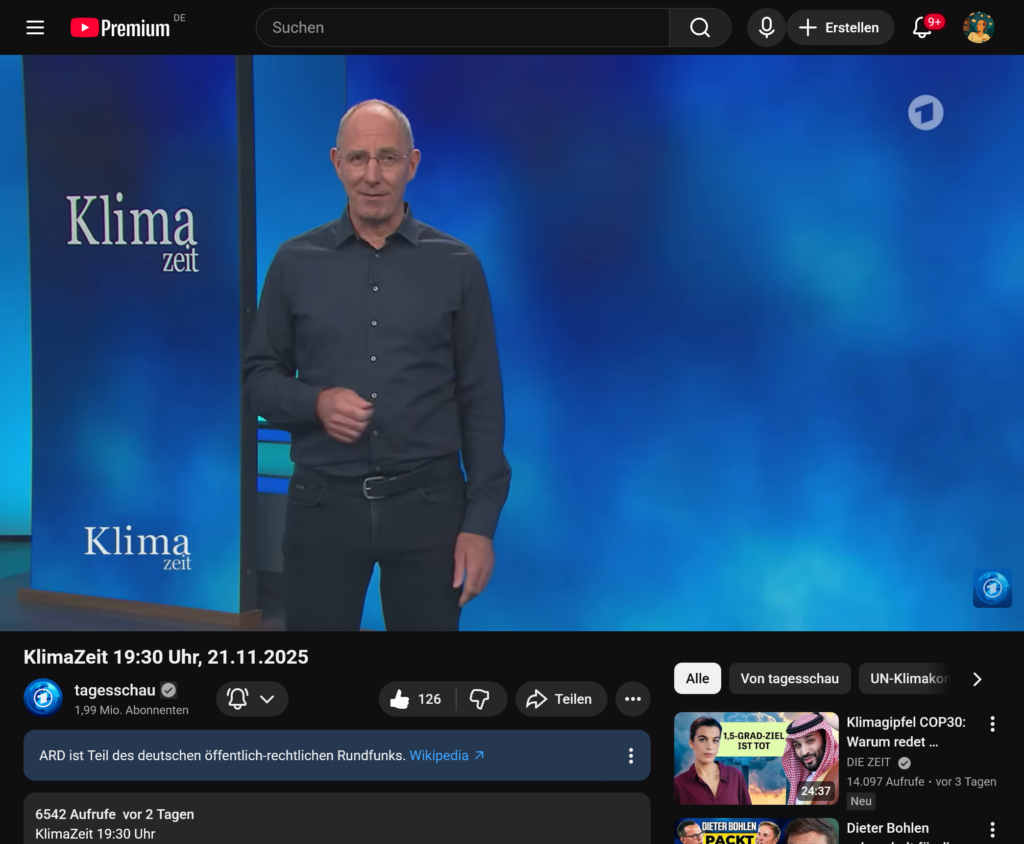
Image: Screenshot daily news YouTube appearance “KlimaZeit 7:30 p.m., 21 November 2025 | Tagesschau: Illegal gold mining in the Amazon“. Available online at https://youtu.be/LEWD6HWeSIk Retrieved on 23 November 2025. Editorial use.9 daily news YouTube appearance “KlimaZeit 7:30 p.m., 21 November 2025 | Tagesschau“. Available online at accessed on 23 November 2025. Editorial use. 🌐 https://youtu.be/LEWD6HWeSIk .
Report on illegal gold mining:
- Illegal gold mining is rampant in the Amazon – with disastrous consequences for the ecosystem.
- Mercury use and cyanide poison the soil and waterways, rivers overheat, fish die.
- Indigenous communities are the ones who suffer most. They use drones to document the deforested rainforest, water basins, excavators and gold panning facilities. „This is what it looks like everywhere here.“
- More than two million hectares of forest have been cleared for illegal and legal gold mining.
- Just 10 to 20 kilograms of gold are extracted from 1,500 to 2,000 tonnes of rock (and countless animals whose habitat disappears as a result).
- Poverty drives indigenous people to work in the gold mines.
- Illegal gold mining is also a sign of the absence of state control.

Link to COP30:
The programme draws a direct line: while Brazil talks about protecting the Amazon at COP30, the worst environmental crimes are happening on the ground. This highlights the discrepancy between words and actions – not only in international agreements, but also at the national level.
- Ahead of the COP, indigenous peoples and civil society are protesting more than ever before.
- This COP is no longer about theories, but about implementing climate protection.
- No agreement has been reached so far; not even Germany would have signed the proposals put forward thus far.
10. ZDF heute journal podcast – „COP30 – what did it achieve?“ (Winnie Heesch on site)
ZDF correspondent Winnie Heesch was on site throughout COP30 in Belém and reports in detail in the „heute journal“ podcast.10COP30 – what did it achieve? | heute journal – the podcast 🌐 https://youtu.be/pjuDbT1tGfs .
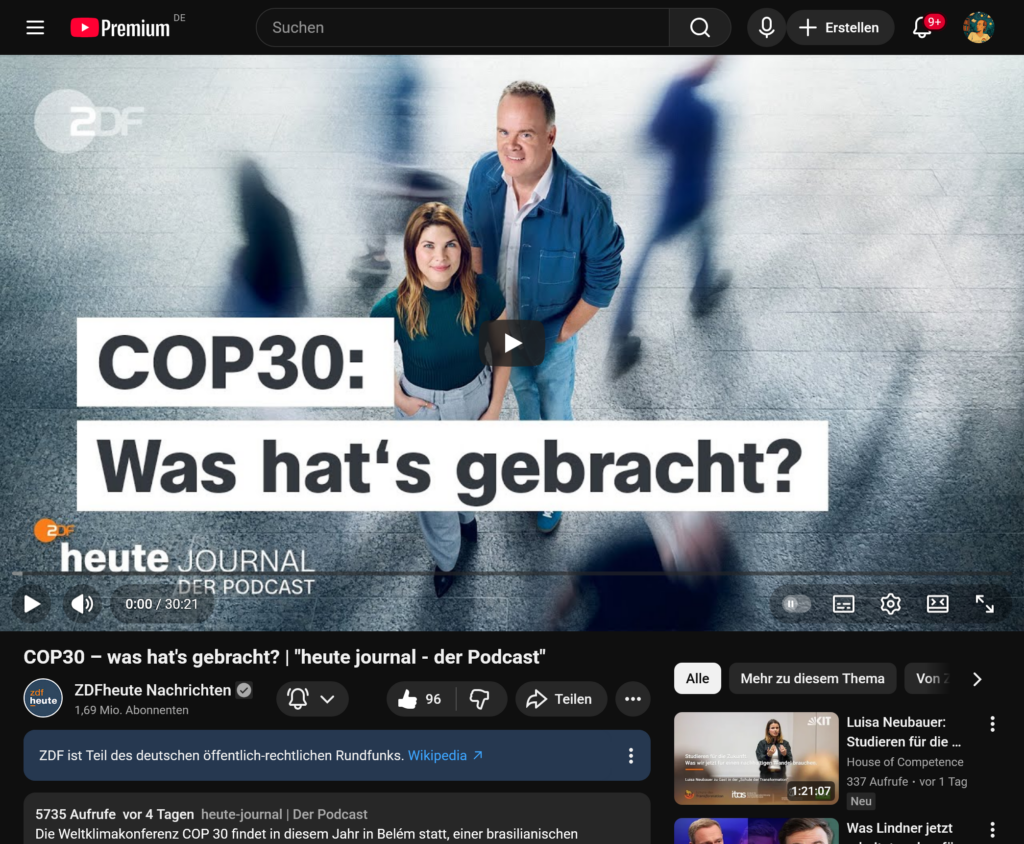
News legend Gundula Gause explains12COP30 – what did it achieve? | heute journal – the podcast 🌐 https://youtu.be/pjuDbT1tGfs :
- „Since 1995, the World Climate Conference has been held every year at different locations. The official name of the event is COP, short for Conference of the Parties, i.e. the conference of the parties to the UN Framework Convention.“
- „The first climate conferences focused on industrialised countries. Most of them committed themselves to reducing their CO₂ emissions for the first time in 1997 in the Kyoto Protocol.“
- „In 2015, there was a breakthrough in Paris. Industrialised countries, as well as developing and emerging countries, agreed that the global temperature increase should be limited to 1.5° Celsius if possible, but in any case well below 2° compared to the pre-industrial era.“
At the conference itself:
- Heesch defends the venue. You can get on a boat here and in half an hour you're in the rainforest, where you can see for yourself the extent of the destruction.
- Personal comment: How many of the 50,000 participants went to see the deforested rainforest like our Chancellor did? None. Our Chancellor Friedrich Merz and his entourage flew home after less than 24 hours.
- The courtrooms were filled with extreme tension.
- The process collapsed several times because countries could not agree.
- Saudi Arabia, Russia, Venezuela and other OPEC countries consistently blocked any progress on the issue of fossil fuels.
- Countries such as Colombia, Fiji and other vulnerable nations (island states) fought desperately for stronger measures – but failed against the blockade.
Emotional dimension:
- Christian Siewers (presenter of the „heute Journal“ news programme) begins by drawing a direct connection to reality, recalling the extreme weather conditions in Valencia, which caused unimaginable damage and claimed several hundred lives.
- And Christian recalls „the South Sea islands that are sinking“.
- Host Helene Reiner paints a picture of melting Alps on the one hand and deforested Amazon rainforest on the other.
- Heesch reports on the despair among the delegations from the Global South
- Many delegates feel that their countries are literally drowning while the international community agrees on minimal compromises.
- A delegate from the Marshall Islands said, „This is not a final document. It is a death certificate.“
On Friedrich Merz:
- Heesch reports critically on Merz's appearance. The damage he has caused is enormous.
- He was only there briefly and made strange comments about the venue.
- Actually, nothing. He arrived in the dark, saw the hotel and the venue, and left.
- Rumour has it that Merz wanted to finally say something nice about Germany after his backfired debate on the cityscape.
- His financial commitment was criticised as being too weak.
- He did not show the commitment one would expect from a climate chancellor.
- Find out how the rest of the world perceived and remembered Germany's performance in this exciting article: The German chancellor's waves beat high
Structural problems:
- Heesch draws a clear conclusion: the COP system cannot work as long as countries have the right of veto.
- 195 countries must agree unanimously – a system that is predestined for deadlock
- Alternative formats are gaining in importance
11. ARD programme „World Climate Conference – What does that have to do with me?“ (discussion programme)
This in-depth 90-minute discussion programme on ARD dealt with the consequences of COP30 for everyone.13World Climate Conference – What does that have to do with me? | mitreden.ard.de 🌐 https://youtu.be/X8LhOSbEn5I .
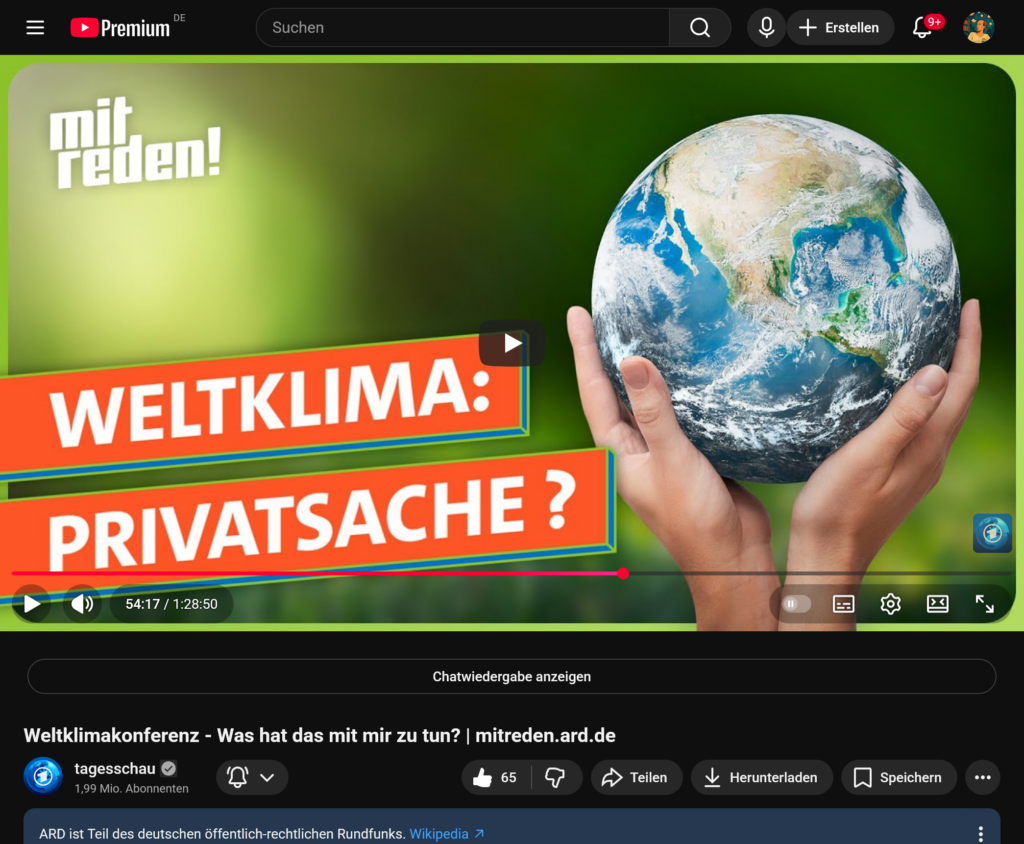
Discussion participants and their positions:
- Climate scientists explain that the measures taken so far are completely inadequate.
- Dr Michael Bilharz, Federal Environment Agency, lives climate-neutrally
- Activists from the Fridays for Future movement criticise the lack of urgency
- Janna Hoppmann, climate psychologist (will be joining us briefly from Belém)
- Business representatives argue on the basis of costs – leading to sharp criticism
- People affected in climate-vulnerable countries report fears for their livelihoods
- Interested members of the public via telephone and YouTube chat or comment function
- Claudia Reiser, ARD Climate Competence Centre
Key points of discussion:
- justiceWho pays for the climate crisis? Who benefits? Who suffers?
- speedAre the measures that have been decided upon fast enough? (Spoiler: No)
- bondingWhy are international agreements not binding? (Answer: Sovereignty of states)
- alternativesWhat works instead of COP?
Key findings:
- The very first caller sums up one of the biggest levers: We Germans emit around 10.4 tonnes of CO2 per year, and switching to a vegan diet could save up to one tonne of CO2 per capita per year, not even taking into account the positive effects in terms of land use.
- Using the example of the sluggish ramp-up of hydrogen production, Claudia Reiser from the ARD Climate Competence Centre describes a problem that is almost symptomatic of climate protection measures: „The whole hydrogen ramp-up is not progressing. It's not working at the moment because it's such a chicken-and-egg problem. Those who would produce hydrogen say, „Yes, we lack buyers because green hydrogen is simply still far too expensive at the moment. And those who want to work with it say: “Well, but there isn't any, it's not available, we don't have the hydrogen core network, etc.“ In this respect, everything has to mesh together, and that requires a certain amount of (...) support, financing, and even subsidies (...)'
- A participant from Bangladesh reports that her country is losing millions due to flooding – while the world debates millions in aid.
- A worker from the coal industry makes it clear: there can be no just transition without financial security for workers.
- Young people are frustrated – they see politicians making promises that are not kept.