

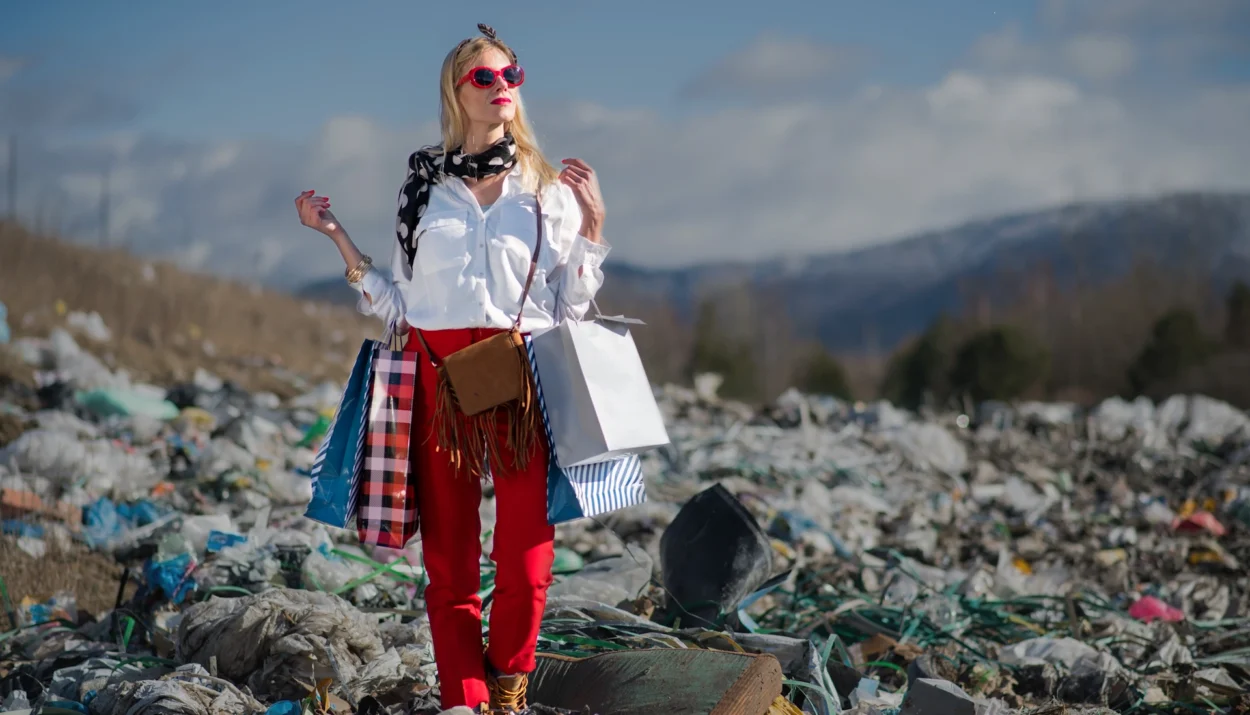
Appeal to our Environment Minister Wolfram Weimer. Apparently he has nothing else to do with black and blue governments. Or have you heard anything from him? Yes? Really? That's exciting, because Wolfram Weimer is Minister of State to the Federal Chancellor and Federal Government Commissioner for Culture and the Media (colloquially: Minister of State for Culture), while our Federal Minister for the Environment goes by the name of Carsten Schneider. This makes it all the more important to send an appeal to our Environment Minister Carsten Schneider.
Vote now against ultra-horrific fast fashion on the Website of Deutsche Umwelthilfe
Fast fashion has become a symbol of a consumer culture that has got out of hand: Clothing is now produced on a piecework basis, often worn only once or twice and then disposed of - with fatal consequences for the climate, resources, labour rights and global mountains of waste. The campaign „Slow Fashion instead of Fast Fashion - Reclaim Responsibility“ by Deutsche Umwelthilfe shows how ultra-fast fashion has developed into one of the biggest environmental problems of our time and why political rules are now needed to finally make fashion brands take responsibility.1 Slow fashion instead of fast fashion! Sign the petition now 🌐 https://mitmachen.duh.de/reclaim-responsibility/
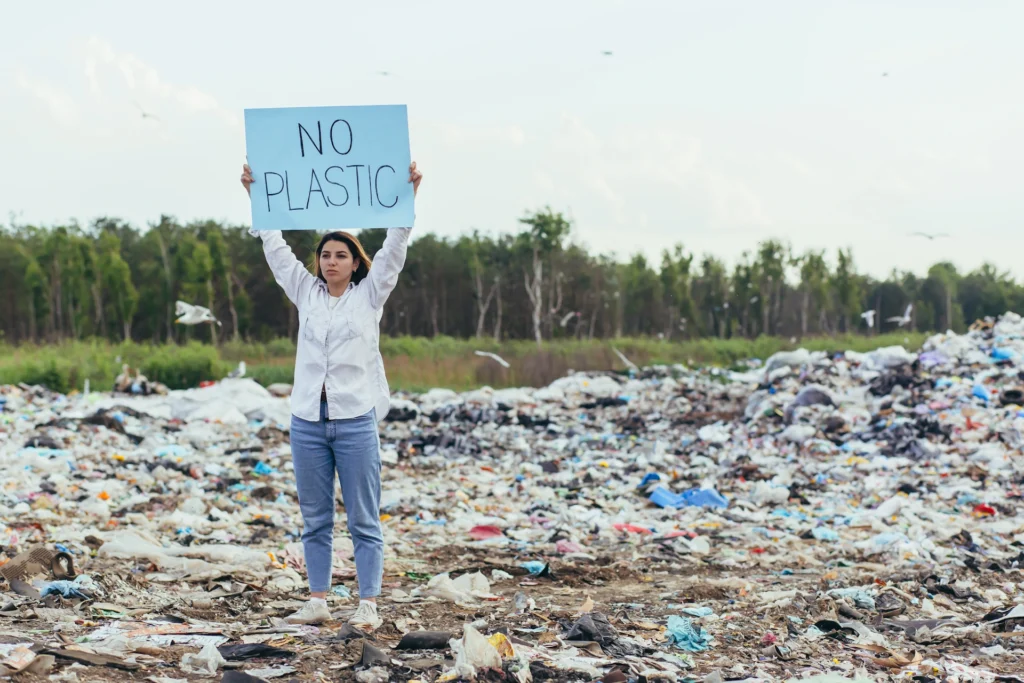
Photo: Woman with sign no plastc on pile of rubbish. envato / voronaman111
When fashion becomes a disposable product
Clothing has become a „disposable plastic product“ in recent years: Many items are made from cheap synthetic fibres and are not designed for longevity or recycling, but for a brief appearance - the famous party top that is worn less than twice on average before it ends up in the bin. At the same time, according to DUH, around 40 per cent of the goods produced remain unsold and are destroyed directly or sent to landfill - often far away from the sales markets in the global North.2 Slow fashion instead of fast fashion! Sign the petition now 🌐 https://mitmachen.duh.de/reclaim-responsibility/
Ultra-fast fashion suppliers release new styles and „must-haves“ every hour; on platforms such as Shein, thousands of designs are pushed onto the market every day at dumping prices. Fashion is becoming cheaper and cheaper, but the true price is reflected in rising CO₂ emissions, polluted waters, toxic chemicals in textiles and massive violations of labour rights along the supply chain.3 Slow fashion instead of fast fashion! Sign the petition now 🌐 https://mitmachen.duh.de/reclaim-responsibility/
Plastic fibres, microplastics and global landfills
A key problem is that large parts of fast fashion clothing are made from synthetic, petroleum-based fibres - „colourful plastic bags in woven form“, as the DUH calls it in a nutshell. These textiles shed microplastic particles with every wash, which end up in rivers and oceans via wastewater, damaging ecosystems there and ending up in the food chain.4 Slow fashion instead of fast fashion! Sign the petition now 🌐 https://mitmachen.duh.de/reclaim-responsibility/
In addition, every second a lorry load of clothing is incinerated or dumped in landfills around the world - not on our own doorstep, but in countries of the global South, where entire „clothing waste beaches“ are created from donated or exported goods. Recycling remains the exception: fibre mixtures, harmful substances and poor quality often prevent textiles from being kept in circulation, so that the system effectively boils down to „produce, use briefly, throw away“.5 Slow fashion instead of fast fashion! Sign the petition now 🌐 https://mitmachen.duh.de/reclaim-responsibility/
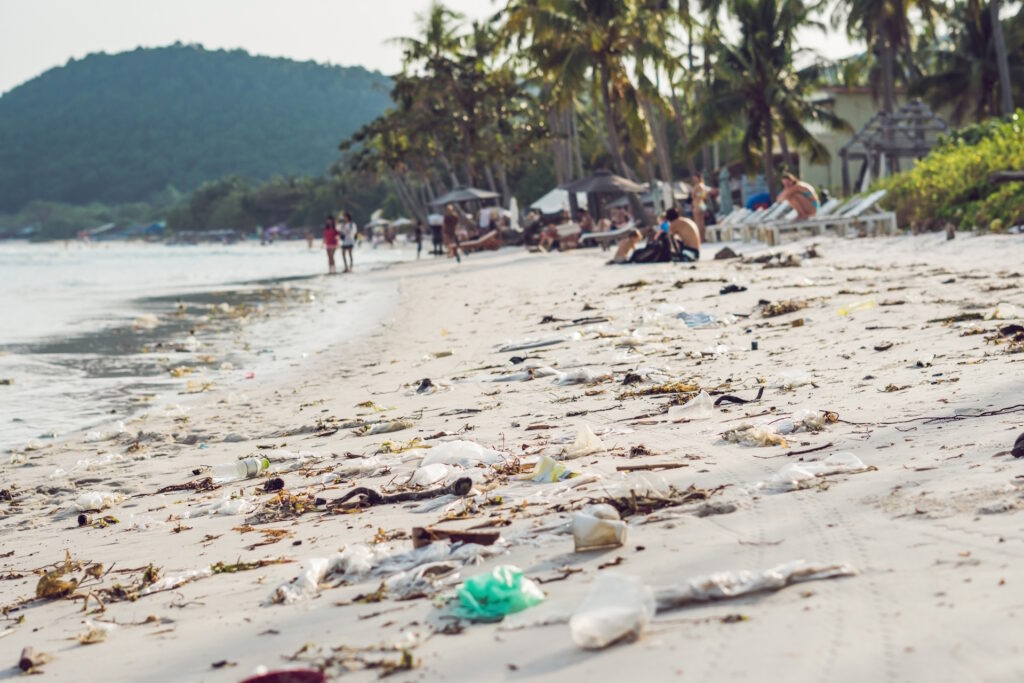
Photo: Rubbish on a beautiful beach. envato / MaplesImages
Linear throwaway model instead of a genuine circular economy
At its core, DUH criticises a linear business model that is based on permanent overproduction and aggressive marketing. Social media and influencer marketing fuel a permanent pressure to buy that keeps consumers in a cycle of buying for pleasure, using for a short time and then throwing away - a „throwaway pressure“ that is deliberately created by fashion companies.6 Slow fashion instead of fast fashion! Sign the petition now 🌐 https://mitmachen.duh.de/reclaim-responsibility/
The problem: fashion brands have so far hardly borne the costs for the disposal of their products or the ecological and social damage along the supply chain. Profits remain with the companies, while the climate, environment and people in production and disposal countries foot the bill - from CO₂ emissions, water consumption and pollution to poor wages and dangerous working conditions.7 Slow fashion instead of fast fashion! Sign the petition now 🌐 https://mitmachen.duh.de/reclaim-responsibility/
Photo: Men looking for Black Friday clothing offers. envato / DC_Studio
Policy window: Extended Producer Responsibility (EPR)
Things get exciting where the petition speaks of a „historic opportunity“: the EU has adopted a directive on extended producer responsibility (EPR) for textiles, which Germany must transpose into national law by summer 2027 at the latest. The idea behind it: Manufacturers should not only be responsible up to the point of sale, but should also pay for the collection, reuse, repair and recycling of their products and fulfil specific targets.
The DUH points out that countries such as France and the Netherlands are already showing how this can work - for example through legal requirements for second use, repair and recycling obligations and penalties for particularly harmful ultra-fast fashion models. This is precisely the path that Germany should take instead of hoping for voluntary commitments from the industry that will never materialise.8 Slow fashion instead of fast fashion! Sign the petition now 🌐 https://mitmachen.duh.de/reclaim-responsibility/
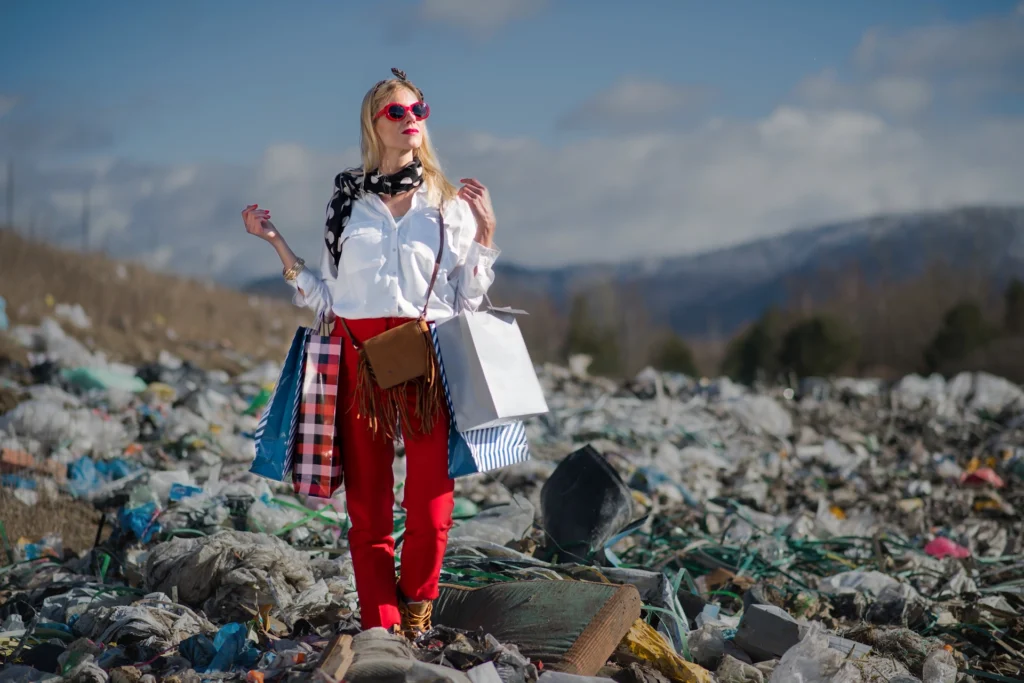
Cover picture: Woman at the landfill, envato / GroundPicture
What the petition specifically demands
The petition to Federal Environment Minister Carsten Schneider calls for a reorganisation of the economic framework conditions in the textile industry in order to curb overproduction and keep textiles in the cycle. Only if ecological and social costs are priced in along the entire supply chain can the industry develop from a linear throwaway model to a genuine circular economy.
Specifically, the DUH demands, among other things9 Slow fashion instead of fast fashion! Sign the petition now 🌐 https://mitmachen.duh.de/reclaim-responsibility/ :
- Binding target quotas for waste avoidance and high reuse rates, including outside Germany,
- a fund into which at least 25 per cent of EPR contributions are channelled in order to make second-hand, upcycling, professional rental models and repair services widespread and affordable,
- Framework conditions that make overproduction and the destruction of unsold goods unattractive and instead promote circular business models.
Join in now and petition here sign: Website of Deutsche Umwelthilfe